Have you ever received a message containing a semicolon (;) and wondered why someone used it instead of a comma or period? Perhaps you have seen it in a social media caption, a professional email, or a sentence in a book. Although it looks like a small punctuation mark, the semicolon can carry several meanings depending on where and how someone uses it.
The semicolon meaning can be confusing because it serves different purposes in writing and digital communication. In grammar, it connects closely related independent clauses or separates complicated items in a list. In texting, people sometimes use it to create a particular tone, express a playful wink, or communicate subtle emotions.
The symbol also has cultural and personal meanings. For example, the semicolon has become a powerful symbol of hope, mental health awareness, and continuing life despite difficult experiences.
Understanding these different uses can help you interpret messages correctly and improve your writing. Whether you encountered a semicolon in a text message, online post, relationship conversation, or formal document, this guide explains what it means and when to use it.
Quick Definition of “Semicolon Meaning”
The semicolon (;) is a punctuation mark that connects two closely related independent clauses or separates complex items in a list. In texting, it can create a wink-like expression or suggest a particular tone. It also represents hope, survival, and mental health awareness through the semicolon movement.
Primary meaning: A semicolon is a punctuation mark that connects related ideas without completely separating them.
Secondary meanings include:
- A playful or flirty wink in informal messages.
- A symbol of hope and personal strength.
- A sign of mental health awareness and suicide prevention.
- A way to organize complicated information in writing.
Its meaning depends on the situation, sentence, and relationship between the people communicating.
RELATED MEANINGS
Explore more texting meanings from Meaningsbridge
Your Premium Guide to Texting Meanings
Detailed Meaning Breakdown
The semicolon is one of the most useful punctuation marks in English. It sits between a comma and a period in appearance, but its grammatical function is different from both.
Let’s explore its main meanings.
1. Semicolon as a Grammar Symbol
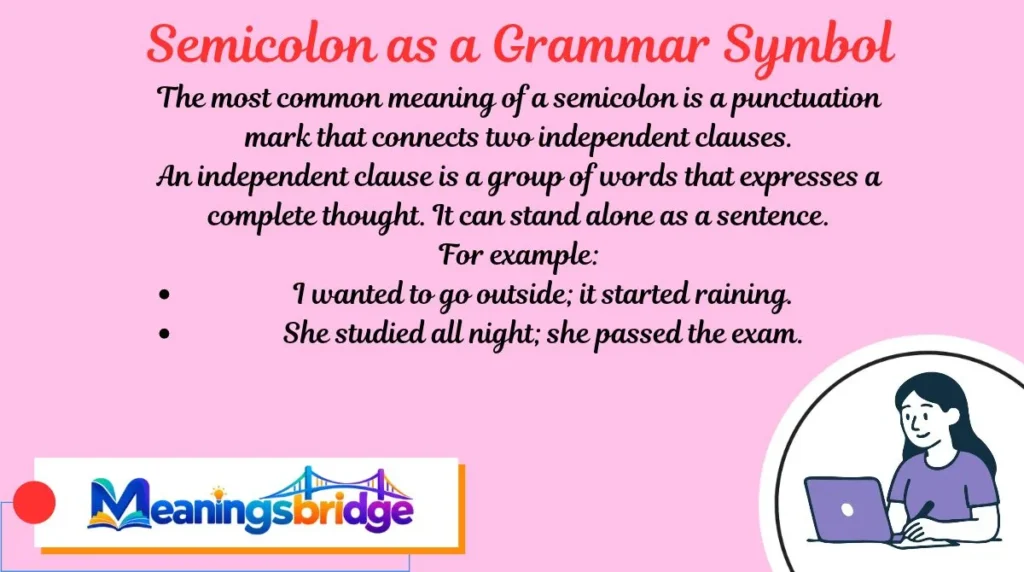
The most common meaning of a semicolon is a punctuation mark that connects two independent clauses.
An independent clause is a group of words that expresses a complete thought. It can stand alone as a sentence.
For example:
- I wanted to go outside; it started raining.
- She studied all night; she passed the exam.
- He loves reading; his sister prefers movies.
In each example, both sides could work as separate sentences.
The semicolon connects them because their meanings are closely related.
Compare these sentences:
Without a semicolon:
I wanted to go outside. It started raining.
With a semicolon:
I wanted to go outside; it started raining.
Both versions are grammatically correct. However, the semicolon creates a stronger connection between the two ideas.
2. Semicolon as a List Separator
A semicolon can also separate items in a complicated list, especially when individual items already contain commas.
For example:
We visited Lahore, Pakistan; Dubai, UAE; and London, England.
The semicolons make the list easier to understand.
Without them, the commas inside the place names could make the information confusing.
Another example:
The meeting included Sarah, the marketing manager; James, the sales director; and David, the company owner.
Here, semicolons clearly separate the three people and their descriptions.
3. Semicolon in Texting
In informal digital communication, a semicolon sometimes appears as part of a text-based emoticon.
The combination 😉 is commonly used to represent a wink.
For example:
- I know what you mean 😉
- You’re looking good today 😉
- Don’t tell anyone 😉
The wink can communicate humor, teasing, friendliness, or flirtation.
However, it does not always indicate romantic interest. Friends may also use it to make a joke feel playful.
4. Semicolon as a Symbol of Hope
The semicolon has a special meaning beyond grammar and texting.
It represents the idea that a person’s story is not over.
In writing, an author could have ended a sentence with a period but chose to continue it with a semicolon. Similarly, the semicolon movement uses the symbol to represent choosing to continue living despite difficult experiences.
It is commonly connected with:
- Mental health awareness.
- Suicide prevention.
- Hope and recovery.
- Strength during difficult times.
- Personal growth and survival.
Some people wear semicolon tattoos to express their personal experiences or show support for others.
5. Rare and Specialized Uses
The semicolon also appears in several technical and specialized settings.
Programming: Some programming languages use semicolons to mark the end of statements.
Example:
let name = "Alex";
console.log(name);
Academic writing: Writers use semicolons to connect closely related statements and organize detailed arguments.
Legal writing: Semicolons can separate complex clauses and conditions within long sentences.
Lists and references: They can separate different pieces of information where ordinary commas would cause confusion.
These uses show that the semicolon is more than a simple punctuation mark.
What “Semicolon” Means in Different Situations
The semicolon’s meaning changes depending on the communication platform and the relationship between the people using it.
Everyday Texting of Semicolon

In everyday texting, the semicolon can serve different purposes.
The most recognizable informal use is the wink emoticon ;).
For example:
- See you tomorrow 😉
- I already know your secret 😉
- That was a funny joke 😉
The wink adds a playful feeling to an otherwise ordinary sentence.
Some people also use semicolons naturally because they are comfortable with proper punctuation.
For example:
“I finished my homework; now I’m free.”
Here, the semicolon has its normal grammatical meaning rather than an emotional one.
Important: A semicolon by itself does not automatically mean flirting, sarcasm, or romantic interest. Always consider the complete message.
Social Media Platforms
On social media, the semicolon appears in captions, comments, hashtags, and personal posts.
Its meaning depends on the content.
In Instagram captions:
Someone might write:
“Still growing; still learning; still becoming stronger.”
The semicolon creates a thoughtful rhythm and connects related ideas.
On TikTok:
People may use semicolon tattoos, artwork, or related hashtags to express mental health awareness and personal resilience.
On Facebook:
A person might share a semicolon image to support someone experiencing emotional difficulties or to celebrate recovery.
In online conversations:
The 😉 emoticon can make comments sound playful or teasing.
Social media has therefore helped expand the semicolon’s meaning beyond traditional grammar.
Dating & Relationships
In dating conversations, the semicolon can sometimes communicate a playful or flirty tone.
For example:
“You looked amazing last night ;)”
The wink suggests that the person may be teasing or expressing attraction.
Another example:
“I have something special planned for you ;)”
The symbol creates curiosity and adds a playful feeling.
However, the semicolon is not a reliable way to measure romantic interest.
Some people use winks with everyone, while others rarely use them.
In relationships, the semicolon can also carry a deeper meaning when connected to mental health, emotional recovery, or personal experiences.
A semicolon tattoo might represent a difficult period that someone has overcome.
If your partner shares this symbol, avoid making assumptions. Ask about its personal meaning if they feel comfortable discussing it.
Professional Communication
In professional communication, the semicolon is mainly used according to standard grammar rules.
It helps connect related thoughts and organize complicated information.
For example:
“The project is almost complete; the final review will take place tomorrow.”
This sentence sounds professional and clearly connects two related statements.
Other examples include:
- The proposal has been approved; the finance team will release the budget next week.
- We received the documents; our legal department is reviewing them.
- The deadline is approaching; all departments must submit their reports.
However, avoid using the semicolon emoticon 😉 in formal business emails, reports, or official documents.
Professional writing should focus on clarity and an appropriate tone.
Cultural or Regional Differences
The grammatical meaning of a semicolon remains generally consistent across English-speaking countries.
However, its informal and symbolic meanings may vary.
In many online communities, 😉 is recognized as a wink. In other communities, people may prefer emojis such as 😉.
The semicolon movement is also recognized internationally as a symbol of mental health awareness and personal resilience.
However, not everyone knows about this symbolic meaning.
A person who sees a semicolon tattoo may understand it as a fashion choice unless they know its background.
The safest approach is to consider the surrounding message and avoid assuming that everyone interprets the symbol in the same way.
Psychological & Tone Analysis Of “Semicolon”
The semicolon may look like a small punctuation mark, but its use can influence how readers understand a message.
Its psychological and emotional meaning depends on the context.
Why People Use Semicolons
People use semicolons for several reasons.
To connect related thoughts: Writers use them when two complete sentences share a close connection.
To improve readability: They help readers understand complicated lists and detailed information.
To express playfulness: In texting, 😉 can make a message feel less serious.
To communicate support: The semicolon symbol can show solidarity with people experiencing mental health challenges.
To express personal strength: Some people use the symbol to represent their journey through difficult experiences.
What It Signals Socially
The semicolon can communicate different social signals.
| Use | Possible social signal |
|---|---|
| Grammar | Clear and organized writing |
| 😉 in texting | Playfulness or teasing |
| Dating messages | Possible flirtation |
| Social media posts | Personal expression |
| Semicolon tattoo | Hope and resilience |
| Mental health campaigns | Awareness and support |
These signals are not universal rules. They are common interpretations that depend on the person and situation.
The Emotional Layer Behind It
The semicolon movement gives this punctuation mark a particularly meaningful emotional connection.
A period can represent an ending. A semicolon, in this symbolic interpretation, represents a pause followed by continuation.
For people who identify with the movement, the symbol may represent:
- Choosing to continue after a difficult experience.
- Finding hope during emotional struggles.
- Accepting personal imperfections.
- Recognizing the importance of mental health.
- Supporting people who feel alone.
It is important to remember that not everyone who uses a semicolon has the same personal story.
The meaning belongs to the individual, and their experience should be respected.
15 Real Conversation Examples (Explained)
The following conversations show how people use semicolons in different situations.
1. Connecting Two Related Ideas
Person A: Did you finish the assignment?
Person B: Yes; I submitted it this morning.
Explanation: The semicolon connects two complete thoughts. It shows that the assignment is finished and has already been submitted.
2. Expressing a Playful Wink
Person A: I know you were waiting for my message 😉
Person B: Maybe I was!
Explanation: The 😉 symbol represents a wink. It gives the conversation a playful feeling.
3. Flirting With Someone
Person A: You looked really cute today 😉
Person B: Haha, thank you!
Explanation: The wink adds a flirty tone to the compliment. It may suggest attraction, depending on their relationship.
4. Making a Joke
Person A: I promised myself I wouldn’t eat another pizza.
Person B: And you ordered two more 😉
Explanation: The wink makes the response sound humorous and teasing rather than judgmental.
5. Showing Excitement
Person A: Are you coming to the party?
Person B: Of course; I’ve been waiting all week!
Explanation: The semicolon connects the person’s answer with their reason for being excited.
6. Sharing Personal Growth
Person A: How have you been lately?
Person B: Better than before; I’m finally focusing on myself.
Explanation: The semicolon connects two related thoughts about personal improvement.
7. Writing an Instagram Caption
Person A: What caption are you using for your new picture?
Person B: Learning every day; becoming stronger every year.
Explanation: The semicolon separates two connected ideas and creates a reflective tone.
8. Showing Support
Person A: I have been through a lot this year.
Person B: Your story isn’t over; keep believing in yourself.
Explanation: The semicolon connects encouragement with a message of hope.
9. Organizing a Complicated List
Person A: Who attended the meeting?
Person B: Sarah, our designer; Mark, our manager; and Alex, our developer.
Explanation: The semicolons separate names from their job descriptions and make the list easier to understand.
10. Professional Communication
Person A: Is the report ready?
Person B: Yes; the final version is waiting for approval.
Explanation: The semicolon connects two complete and closely related statements in a professional conversation.
11. Adding a Playful Warning
Person A: Don’t eat my chocolate!
Person B: Too late; it was delicious 😉
Explanation: The semicolon connects the action with the reaction, while the wink adds humor.
12. Expressing Determination
Person A: Are you giving up on your goal?
Person B: Never; I’m just taking a short break.
Explanation: The semicolon connects a strong statement with an explanation. It communicates determination.
13. Talking About a Relationship
Person A: Do you miss me?
Person B: More than you know 😉
Explanation: The wink creates a playful or romantic tone. The exact meaning depends on the relationship.
14. Sharing a Personal Story
Person A: Why do you have a semicolon tattoo?
Person B: It reminds me that my story continues.
Explanation: Here, the semicolon represents hope, resilience, and continuing life after difficult experiences.
15. Discussing Plans
Person A: What are you doing this weekend?
Person B: Saturday is for studying; Sunday is for relaxing.
Explanation: The semicolon connects two related plans while keeping the sentence easy to read.
When “Semicolon” Can Be Misunderstood
Although the semicolon has clear grammatical rules, its informal and symbolic meanings can sometimes create confusion.
Here are some common reasons.
1. Confusing a Semicolon With a Wink
Some people interpret every semicolon as part of a wink emoticon.
However, a semicolon used in a normal sentence has a completely different function.
For example:
“I called him; he didn’t answer.”
This is ordinary punctuation, not flirting.
The wink only appears when the semicolon is combined with a closing parenthesis:
😉
2. Confusing a Semicolon With a Colon
A semicolon (;) and a colon (:) look similar, but they have different grammatical functions.
A semicolon generally connects closely related independent clauses.
A colon commonly introduces an explanation, list, example, or quotation.
For example:
Semicolon: I wanted to travel; my budget was limited.
Colon: I need three things: a notebook, a pen, and a laptop.
Mixing them up can make writing confusing.
3. Generational Differences
Younger and older internet users may interpret informal punctuation differently.
Some people frequently use text emoticons, while others prefer modern emojis.
For example, a younger user may recognize 😉 as a playful wink immediately.
Someone less familiar with digital slang might interpret it as unusual punctuation.
These differences can lead to misunderstandings.
4. Platform Differences
The same symbol may communicate different things on different platforms.
- In emails, it usually follows grammatical rules.
- In text messages, 😉 can represent a wink.
- On Instagram, it may appear in captions or personal posts.
- In mental health communities, it may represent hope and awareness.
- In programming, it may mark the end of a statement.
Understanding the platform helps you identify the intended meaning.
5. Assuming Every Semicolon Has an Emotional Meaning
A semicolon tattoo may have personal significance, but not every semicolon in a message represents mental health awareness.
Likewise, a person using 😉 is not necessarily flirting.
Always look at the complete conversation before deciding what someone means.
Similar Words, Symbols, or Abbreviations of “Semicolon”
Several punctuation marks and symbols have functions similar to the semicolon. However, they are not interchangeable.
Here are 10 related terms worth understanding.
| Symbol or term | Meaning | Example |
|---|---|---|
| Period (.) | Ends a complete sentence | I am happy. |
| Comma (,) | Separates words, phrases, or clauses | I came, I saw, I left. |
| Colon (:) | Introduces a list or explanation | Bring these: books and pens. |
| Dash (—) | Shows a break or adds emphasis | I tried—but failed. |
| Parentheses ( ) | Add extra information | She arrived (after lunch). |
| Apostrophe (‘) | Shows possession or missing letters | Sarah’s book |
| Exclamation mark (!) | Expresses strong emotion | That’s amazing! |
| Question mark (?) | Marks a direct question | Are you coming? |
| Ellipsis (…) | Shows an omission or unfinished thought | I thought you would… |
| Wink emoji (😉) | Expresses playfulness or teasing | See you soon 😉 |
How Is a Semicolon Different From a Comma?
A comma creates a shorter pause and separates parts of a sentence.
A semicolon connects two closely related independent clauses.
For example:
Comma: I bought apples, oranges, and bananas.
Semicolon: I bought apples; my sister bought oranges.
A comma alone should not normally join two independent clauses without an appropriate conjunction.
How Is a Semicolon Different From a Period?
A period completely ends a sentence.
A semicolon connects two complete thoughts that are closely related.
For example:
Period: She was tired. She went to bed.
Semicolon: She was tired; she went to bed.
Both are correct, but the semicolon highlights the relationship between the ideas.
When Not to Use “Semicolon”
Although semicolons are useful, they are not appropriate in every situation.
Using them incorrectly can make writing confusing or create the wrong tone.
1. When the Two Ideas Are Not Related
Avoid connecting completely unrelated thoughts with a semicolon.
Incorrect:
I like coffee; my brother plays football.
The two statements do not have a clear connection.
Better:
I like coffee. My brother plays football.
Use a semicolon when the two ideas share a meaningful relationship.
2. When Writing Very Simple Sentences
You do not need a semicolon in every sentence.
For example:
“I am hungry; I need food.”
This is grammatically possible, but two simple sentences may sound more natural.
“I am hungry. I need food.”
Choose the punctuation that makes your writing easiest to understand.
3. In Formal Communication When Using 😉
Avoid using the wink emoticon in serious business communication.
For example:
“Your payment is overdue ;)”
This could make the message seem unprofessional or disrespectful.
A direct and polite sentence is better:
“Your payment is overdue. Please arrange payment at your earliest convenience.”
4. When the Symbol’s Meaning Is Unclear
Do not assume that everyone understands the semicolon movement or informal emoticons.
If you are discussing a sensitive subject, use clear language instead of relying on a symbol.
5. When It Creates a Run-On Sentence
A semicolon should connect two independent clauses.
Incorrect:
I went to the store; because I needed milk.
The second part is not an independent clause.
Correct:
I went to the store because I needed milk.
A semicolon cannot replace every comma or conjunction.
Expert Tips for Using “Semicolon” Correctly
Understanding the semicolon becomes easier when you follow a few simple rules.
1. Check Both Sides of the Semicolon
Make sure both sides can stand alone as complete sentences when using it to connect clauses.
Example:
“I was late; the traffic was terrible.”
Both parts express complete thoughts.
2. Connect Related Ideas
Use semicolons when two statements share a close connection.
Example:
“She worked hard; she achieved her goal.”
The ideas naturally belong together.
3. Use It for Complicated Lists
When list items already contain commas, semicolons can separate them more clearly.
Example:
“The guests came from Lahore, Pakistan; Delhi, India; and London, England.”
4. Do Not Confuse It With a Colon
Remember the basic difference:
- Semicolon: Connects related complete thoughts.
- Colon: Introduces an explanation, list, or example.
5. Understand the Context in Texting
If someone sends ;), consider the surrounding words.
It may express humor, friendliness, teasing, or flirtation.
Do not automatically assume romantic interest.
6. Respect Its Symbolic Meaning
If someone uses a semicolon tattoo or shares a semicolon-related message, understand that it may represent something personal.
Avoid making assumptions about their mental health or personal history.
7. Keep Professional Messages Clear
Use standard punctuation in reports, business emails, and formal documents.
Avoid unnecessary emoticons when communicating with clients, managers, or professional contacts.
8. Prioritize Readability
A semicolon should make your writing easier to understand, not harder.
If a period or comma works better, use it.
Good writing is about communicating clearly rather than using complicated punctuation.
Frequently Asked Questions
1. What does a semicolon mean in text messages?
A semicolon (;) is usually a punctuation mark that connects two related thoughts. However, when combined with a closing parenthesis to create ;), it represents a wink. In informal texting, this can communicate humor, friendliness, teasing, or flirtation. The intended meaning depends on the surrounding message.
2. What does 😉 mean from a girl or boy?
The symbol 😉 represents a wink and can suggest playfulness, humor, teasing, or romantic interest. If someone sends it after a compliment, they may be flirting. However, it does not automatically mean attraction. Their usual texting habits and the conversation’s context are important.
3. What does a semicolon mean spiritually?
The semicolon is commonly associated with hope, personal growth, survival, and continuing life after difficult experiences. Some people connect it with overcoming emotional struggles and finding strength. Although it is not a universal religious symbol, it can carry deep personal meaning for those who identify with its message.
4. Why do people get semicolon tattoos?
People often get semicolon tattoos to represent hope, resilience, and mental health awareness. The symbol reflects the idea that their story is continuing rather than ending. It is also associated with the Semicolon Project and the broader conversation about suicide prevention and emotional well-being.
5. Does a semicolon mean flirting?
A semicolon alone does not mean flirting. However, the emoticon 😉 is often used to create a playful or suggestive tone. Someone might use it when teasing a friend or expressing romantic interest. You should consider the person’s words, behavior, and relationship with you before interpreting it as flirting.
6. What is the difference between a semicolon and a colon?
A semicolon (;) connects two closely related independent clauses or separates complicated list items. A colon (:) introduces information such as a list, explanation, example, or quotation. For example, “I was tired; I went home” uses a semicolon, while “I need three things: food, water, and rest” uses a colon.
7. What does a semicolon mean in mental health awareness?
In mental health awareness, the semicolon represents hope and the decision to continue living despite difficult experiences. It is often associated with suicide prevention, recovery, and emotional resilience. People may use semicolon tattoos, artwork, or social media posts to express their personal journeys or show support for others.
8. Is using a semicolon in texting rude or formal?
No. A semicolon is not inherently rude or overly formal. It is a normal punctuation mark used to connect related thoughts. However, the 😉 emoticon can make a message sound playful or teasing. In professional communication, traditional punctuation is generally more appropriate than informal emoticons.
Conclusion
The semicolon (;) is a small symbol with several important meanings in modern communication. Its primary purpose is to connect closely related independent clauses or separate complicated items in a list. However, its meaning extends beyond traditional grammar.
In texting, 😉 often represents a wink and can communicate humor, friendliness, or flirtation. On social media, the semicolon may appear in captions, personal posts, and mental health awareness campaigns. It can also represent hope, survival, and the decision to continue moving forward.
The most important thing is understanding the context. A semicolon in a professional email has a different purpose from one in a playful text message or a meaningful tattoo.
Once you understand these differences, you can interpret the symbol more confidently and use it correctly in your own communication. Whether you are writing an important document, sending a casual message, or exploring its emotional symbolism, the semicolon shows how one small punctuation mark can communicate so much.