
When someone sends you a single “L” in a text, it can be surprisingly hard to know what they mean.
You might see “L” after someone loses a game, under a social media post, or in a chat where a friend is joking about another person. In some cases, it can even have a completely different meaning based on the conversation.
This small letter has become a useful piece of internet and texting slang. Most often, L means “loss” or “a losing moment,” especially when someone fails, loses an argument, makes a mistake, or experiences an embarrassing situation. It is often used as the opposite of “W,” meaning “win” or “winning.”
However, context matters. “L” can sound playful between friends but rude or insulting when directed at someone during a serious conversation. It can also have other meanings in specific communities and situations.
This guide explains what L means in text, where the expression comes from, how people use it, what emotional tone it carries, and when you should avoid using it.
Quick Definition of “L Meaning in Text”
In text messages and online conversations, “L” usually means “loss” or “losing,” and it is used to describe a defeat, mistake, failure, or embarrassing situation. It is commonly used as internet slang and is often contrasted with “W,” which means “win.” In some contexts, “L” can have other meanings.
Detailed Meaning Breakdown
The primary meaning of L
The most common meaning of L in texting is “loss.”
If someone loses a competition, makes a bad decision, receives an unfavorable result, or gets embarrassed, another person may simply reply:
“L”
The message means something like “That’s a loss,” “You lost,” or “That was a bad outcome.”
The exact meaning depends on the situation.
L as “Loss”
This is the most common modern slang meaning.
For example:
“Our team lost again.”
Reply:
“L”
Here, “L” recognizes the defeat.
The term can also describe a personal mistake:
“I forgot to submit my assignment.”
Reply:
“Big L.”
The speaker is calling the mistake a loss or failure.
L as “Loser”
Sometimes “L” is used to insult a person rather than describe an event.
For example:
“He really did that?”
“L.”
In this case, the meaning can be closer to “What a loser” or “That person took an L.”
This use is more confrontational and should be handled carefully.
L as “Take the L”
The expression “take the L” means accepting a loss, defeat, mistake, or disappointing outcome.
For example:
“I argued with him for an hour and realized I was wrong. I guess I’ll take the L.”
The person is admitting that they lost the argument or made a mistake.
L as the Opposite of W
Online slang often places L and W together.
- L = loss, losing, failure
- W = win, winning, success
Someone might write:
“That was a W.”
to celebrate a positive result.
Or:
“That’s an L.”
to point out a negative result.
This simple contrast makes the slang easy to recognize in gaming, sports, social media, and casual conversations.
Other Possible Meanings of L
Although “loss” is the dominant slang meaning, L does not always mean loss.
Depending on the conversation, L might refer to:
- Love in a personal or romantic context
- Laughing in some informal shorthand systems
- Left when discussing direction or location
- Learner in driving-related contexts
- A person’s initial
- A grade or letter
- A shortened form of another word
Therefore, never interpret a single “L” without considering the surrounding conversation.
What “L Meaning in Text” Means in Different Situations
Everyday Texting of L
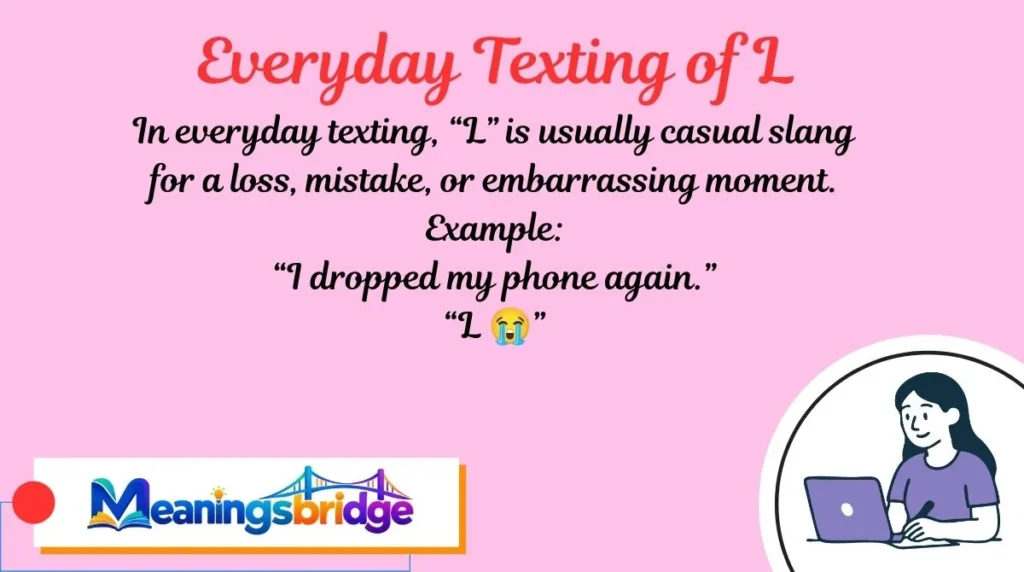
In everyday texting, “L” is usually casual slang for a loss, mistake, or embarrassing moment.
Example:
“I dropped my phone again.”
“L 😭”
The response is probably teasing rather than expressing serious criticism.
The emoji can make the intended tone clearer. A laughing or crying emoji may signal that the person is joking.
Social Media Platforms
On social media, “L” is often used in comments and replies.
Someone may comment:
“L”
on a post about an unpopular decision, failed attempt, bad performance, or controversial opinion.
You may also see:
“Huge L”
“Massive L”
“Common L”
“Take the L”
These expressions usually emphasize that someone experienced an obvious loss or poor outcome.
Social media usage can be harsher because the comment may come from someone who does not know the person personally.
Dating & Relationships
In dating conversations, “L” can be playful or insulting.
For example:
“She said no.”
“L bro.”
This could mean, “That’s unfortunate—you got rejected.”
Among close friends, it may be harmless teasing. Between strangers, however, it can feel insensitive.
There is also another possible meaning. In some romantic conversations, L may be shorthand for “love,” particularly when someone is using initials or abbreviations.
For this reason, context is especially important in relationship-related conversations.
Professional Communication
Using “L” to mean “loss” is generally inappropriate in formal workplace communication.
A coworker might understand:
“We took an L on that project.”
but it is still casual slang.
In a professional email, clearer language would be:
“The project did not achieve the expected result.”
or:
“We experienced a loss on this project.”
Professional communication should prioritize clarity over internet slang.
Cultural or Regional Differences
Internet slang spreads across countries and languages, but its use is not identical everywhere.
Younger internet users are more likely to understand L = loss because the expression appears frequently in gaming, memes, sports discussions, and social media.
Older people or people who are less active online may interpret “L” literally as the letter itself or may not understand the slang at all.
The meaning can also change inside specific communities. Always consider who is speaking, where the conversation is happening, and what was said immediately before the “L.”
Psychological & Tone Analysis Of “L Meaning in Text”
Why does someone use only one letter instead of writing “You lost”?
The short answer is speed, shared internet culture, and emotional impact.
“L” is quick to type and easy to recognize. It also carries a stronger social signal than a neutral statement such as “That did not work.”
It Can Signal Teasing
Friends may use “L” as lighthearted teasing.
“I tried to make pancakes and burned them.”
“L 😂”
The speaker may not seriously criticize the person. They are simply joking about the situation.
It Can Signal Judgment
The same word can become negative when someone uses it to judge another person’s behavior.
“He lied to everyone.”
“L.”
Here, the response may express disapproval.
It Can Create Group Identity
Internet slang often helps people show that they understand the same online culture.
Using “L,” “W,” “ratio,” or similar terms can make a conversation feel informal and community-based.
It Can Show Schadenfreude
Sometimes “L” expresses amusement at another person’s failure.
That can make the expression emotionally sharper. If the other person is genuinely upset, replying with “L” may appear cruel rather than funny.
The emotional meaning therefore depends heavily on the relationship between the people involved.
15 Real Conversation Examples Explained
1. Losing a Game
Person A: “I lost the final match.”
Person B: “L.”
Meaning: Person B is jokingly pointing out the loss.
2. Missing a Bus
Person A: “The bus left exactly when I reached the stop.”
Person B: “That’s an L.”
Meaning: The person experienced an unfortunate outcome.
3. A Failed Attempt
Person A: “I tried fixing my laptop and made it worse.”
Person B: “Big L 😭”
Meaning: The friend is teasing the person about making the problem worse.
4. Losing an Argument
Person A: “I checked the facts. You were right.”
Person B: “Take the L.”
Meaning: Accept that you were wrong or lost the argument.
5. Sports
Person A: “Our team lost 4–0.”
Person B: “Huge L.”
Meaning: The defeat was significant.
6. Gaming
Person A: “I missed the easiest shot.”
Person B: “LMAO, L.”
Meaning: The person is laughing at a funny mistake.
7. Dating
Person A: “She rejected my invitation.”
Person B: “L bro.”
Meaning: The friend is teasing the person about rejection.
8. Spending Money
Person A: “I bought it yesterday and now it’s half price.”
Person B: “That’s an L.”
Meaning: The purchase turned out to be financially unfortunate.
9. A Bad Decision
Person A: “I stayed up all night watching movies before my exam.”
Person B: “Massive L.”
Meaning: The speaker considers the decision a poor one.
10. Social Media Argument
Person A: “He deleted his comment after everyone corrected him.”
Person B: “L.”
Meaning: The person is being mocked for losing the argument.
11. Friendly Competition
Person A: “You beat me by one point.”
Person B: “W!”
Person A: “Enjoy it. Next round is mine.”
Meaning: Here, “W” is the opposite of “L” and celebrates victory.
12. Embarrassing Moment
Person A: “I waved back at someone who wasn’t waving at me.”
Person B: “L 😭”
Meaning: Friendly teasing about an awkward moment.
13. Work Situation
Person A: “The client rejected our first proposal.”
Person B: “L.”
Meaning: The person is describing the rejection as a loss, but this wording may be too casual for a workplace.
14. Unexpected Failure
Person A: “I studied for three hours and the exam covered everything I didn’t study.”
Person B: “Pain. L.”
Meaning: The response combines sympathy with slang for an unfortunate result.
15. Serious Situation
Person A: “My application was rejected.”
Person B: “L.”
Meaning: Although technically understandable, this can sound insensitive because the situation is genuinely important to the person.
When “L Meaning in Text” Can Be Misunderstood
The biggest problem with “L” is that it is extremely short and depends on context.
Context Confusion
A single letter can have many meanings.
If someone writes:
“L”
after a sports result, “loss” is likely.
If someone writes:
“I L you”
the intended meaning could potentially be “I love you,” depending on the person’s texting habits.
Never assume that one interpretation is correct without looking at the surrounding words.
Generational Gap
Someone who spends a lot of time on gaming platforms or social media may immediately understand “L.”
Someone unfamiliar with online slang may ask:
“What does L mean?”
This is normal. Slang changes quickly, and not everyone follows the same online vocabulary.
Platform Differences
The meaning is strongest in informal digital spaces such as gaming chats, comment sections, group chats, and meme communities.
A person may understand the expression on social media but find it strange in an email or business document.
Tone Confusion
The sender may intend “L” as a joke, while the receiver interprets it as an insult.
This is particularly common when there are no emojis or additional words to show emotion.
Similar Words, Symbols, or Abbreviations of “L Meaning in Text”
- W — Means “win” or a successful outcome.
- Take the L — Accept a loss, mistake, or defeat.
- Big L — A significant failure or loss.
- Huge L — An exaggerated way to describe a major loss.
- Loss — The standard word represented by “L” in this slang use.
- Fail — An unsuccessful attempt or result.
- F — Can express disappointment or sympathy after a failure, depending on context.
- Loser — Can be used as an insult toward someone who loses or behaves poorly.
- Dub — Internet slang for “W” or a win.
- Win — The direct opposite of a loss and the concept represented by “W.”
When Not to Use “L Meaning in Text”
Although “L” is common online, it is not appropriate everywhere.
Professional Risks
Avoid using “L” in formal emails, reports, presentations, or communication with clients unless you know the environment strongly supports casual language.
Instead of:
“L for the company.”
write:
“This was a setback for the company.”
Cultural Risks
Not everyone understands internet slang. Using “L” with someone unfamiliar with the expression can create confusion.
Tone Risks
Avoid using “L” when someone has experienced something serious, painful, or deeply disappointing.
For example, replying “L” to someone’s message about losing an important opportunity can sound dismissive.
Relationship Risks
Slang can strengthen friendships, but it can also damage relationships when used without sensitivity.
If you are unsure whether someone will find it funny, choose clearer and kinder wording.
Expert Tips for Using “L Meaning in Text” Correctly
1. Check the Context
Look at what happened immediately before the “L.” If someone lost a game or made a mistake, “loss” is probably intended.
2. Consider Your Relationship
“L” works better between close friends than with strangers, customers, teachers, or managers.
3. Watch the Tone
An “L 😂” may sound playful, while a standalone “L” can sound blunt or hostile.
4. Use It for Minor Failures
The expression works best when the situation is light enough for joking.
5. Avoid It During Serious Moments
If someone is dealing with rejection, grief, financial trouble, or another serious problem, use supportive language instead.
6. Remember That Slang Changes
Online meanings evolve. A word that has one meaning in one community may mean something else elsewhere.
7. Don’t Assume Everyone Knows It
If communication matters, spell out the idea instead of relying on a single slang letter.
8. Use “W” and “L” Carefully
These terms are often used as opposites, but labeling every situation as a “win” or “loss” can make conversations sound overly judgmental.
Frequently Asked Questions
What does L mean in text messages?
In most casual texting and online slang, L means “loss” or “losing.” People use it when someone fails, loses a competition, makes a mistake, or experiences an embarrassing outcome.
What does L mean on social media?
On social media, L usually means loss or failure and is often used in comments to criticize or tease someone after an unfavorable event. Its tone can range from playful to insulting.
What does “take the L” mean in texting?
“Take the L” means accept the loss or admit that you were wrong. It is often used after an argument, competition, failed attempt, or embarrassing situation.
What does L mean compared with W?
L means loss, while W means win. The two letters are commonly used as opposites in gaming, sports, social media, and other online communities.
Is L a rude word in texting?
Not necessarily. “L” can be harmless teasing between friends, but it can sound rude or dismissive when directed at someone who is genuinely upset or when used by a stranger.
Can L mean love in texting?
Yes, L can sometimes represent “love,” especially in highly abbreviated or personal conversations. However, “loss” is the more common meaning in modern internet slang when discussing failure or defeat.
Why do people reply with just L?
People use a single “L” because it is short, recognizable, and emotionally expressive. It quickly communicates that they view an event as a loss, failure, or embarrassing moment.
What does a big L mean in texting?
“Big L” means a major loss or significant failure. It is an intensified version of simply saying “L” and is commonly used in casual online conversations.
Conclusion
The most common L meaning in text is “loss” or “losing.” People use it to describe a defeat, mistake, failure, rejection, or embarrassing situation.
It is especially common in social media, gaming, sports discussions, group chats, and other informal online spaces.
Its meaning is closely connected to W, which usually means “win.” Expressions such as “take the L,” “big L,” and “huge L” build on the same idea.
Still, context is essential. “L” can be playful among friends but harsh in a serious conversation. It can also have different meanings, including “love,” depending on the situation.
The safest approach is simple: look at the conversation, consider the relationship, and pay attention to the tone before interpreting or using “L.” When clarity matters more than slang, use the full word instead.